Fate and destiny
Eugene OneginFate and destiny in Eugene Oneguine are voiced at moments when the future cannot be known and when a choice has become irreversible. Before the fatal duel, Vladimir Lenski waits without knowing whether the bullet will strike him; at the novel’s close, Eugene Oneguine imagines happiness as once possible but ruled out by destiny, while Tattiana Larina answers that she is married and asks him to leave her. The contrast makes fate both a language for uncertainty and a name for the consequences that remain.
The Wound and the Unspoken
The poem first invokes destiny through an absence: the narrator reflects that, had Eugene Oneguine known the wound that rankled in Tattiana Larina’s breast—and had Tattiana found him—events might have been otherwise. The conditional phrasing opens a counterfactual space without turning it into an alternative history. The wound is real, but knowledge and mutual recognition are imagined as missed possibilities; fate enters as the distance between what might have happened and what did.
This framing does not establish that an external power directly causes the lovers’ separation. Instead, it gives their emotional history the shape of an unrealized possibility. The conditional remains unresolved, and its force lies in the very fact that the poem cannot show what would have followed. Fate is therefore linked to belated awareness: what was not understood in time acquires the weight of an irreversible loss.
The Unknown Hour
Before the duel, Lenski turns toward the coming dawn and asks what it will reveal. His anxious eyes seek an answer, but all remains hidden in profound mist. The uncertainty is not abstract: he is waiting to learn whether the fatal bullet will penetrate him or pass harmlessly by. The poem sets two sharply opposed outcomes—death and survival—against the inability to distinguish between them before the hour arrives.
Lenski then calls the approaching hour one of life or death predestinate and blesses the labours of the light. His language gives the duel the gravity of a fixed appointment, even as his own preceding question acknowledges that its result is unknown. Destiny here does not disclose the outcome in advance to the person whose life is at stake. It names the approaching decision of the moment while the future remains veiled from him.
Possibility Closed by Destiny
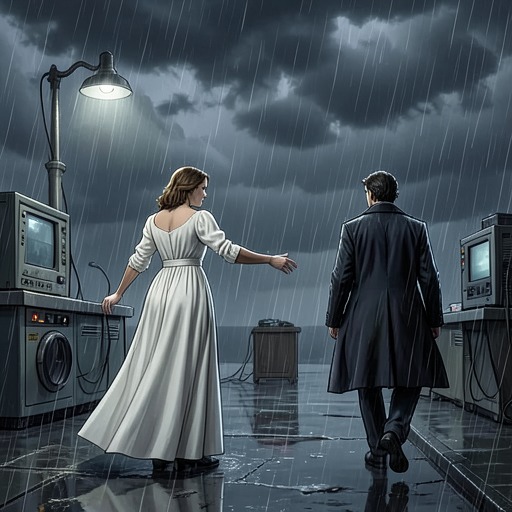
At the ending, Oneguine looks backward and says that happiness had once been possible, perhaps even near, but that destiny decreed otherwise. The shift from the duel scene is decisive: Lenski faces a future whose result he cannot see, whereas Oneguine interprets the past from the far side of lost opportunity. His phrase about happiness near at hand preserves the closeness of what was missed even as his appeal to destiny presents that loss as settled.
Tattiana’s reply places a concrete boundary around that retrospective regret. She says that she is married and supplicates Oneguine to leave her forever. The declaration does not erase her earlier wound or turn the possibility between them into a fulfilled romance; it marks the present consequence of a life already committed elsewhere. Destiny’s final expression is thus not a prediction but a separation maintained through Tattiana’s decision and her marriage.
Thematic Function
Across these passages, destiny changes its relation to time. Before the duel, it is attached to a coming hour, while the answer remains hidden in mist. At the conclusion, it is Oneguine’s explanation of a happiness that he now regards as irretrievably past. The poem places uncertainty and retrospective certainty beside one another without proving that fate mechanically determines either outcome.
The repeated appeal to what might have been gives destiny a tragic double edge: it can make an impending danger feel appointed, and it can make missed chances seem ordained after they have closed. Yet the ending is also specific about human circumstance. Oneguine names destiny, but Tattiana names her marriage and asks him to go. The final separation consequently holds together the language of inevitability and the force of a present choice, leaving the reader with the painful distinction between imagining another life and being able to live it.